

.svg)
.svg)


Timing: 6:00am-2:00pm
Until now, families in the canton of Zug have largely borne the cost of a nursery place themselves. With the canton's revised childcare ordinance and the City of Zug's updated voucher scheme, that is changing fundamentally: from 1 August 2026, two public funding instruments work in tandem, in some cases cutting the effective cost of childcare in Zug considerably. The canton now contributes towards every day of childcare regardless of income, while the city adds a means-tested voucher on top. What this means in practice depends on your family's circumstances – but practically every working family resident in the canton stands to benefit. So what exactly lies behind these two terms?
A fixed, statutory contribution from the canton of Zug towards formal childcare. It amounts to 33% of the average nursery fees in Zug and is paid out regardless of income or assets – provided both parents or legal guardians are in employment or education within the canton.
An additional contribution for residents of the City of Zug, graded according to qualifying family income. This municipal subsidy builds directly on the cantonal flat rate and reduces the remaining cost further – to as little as CHF 15 per day of childcare for those on lower incomes.


The 1st of August 2026 marks a historic turning point for families in the canton of Zug. For the first time, the cantonal government is contributing directly towards monthly childcare costs – combined with the city's new childcare vouchers, this creates a level of financial relief unprecedented in Central Switzerland.
"Families on low and middle incomes will benefit from savings of up to 71 per cent." – City of Zug, announcement dated 7 May 2026
Until now, formal childcare in the canton has been one of the biggest drains on a family's annual budget. With the revised ordinance, policymakers are delivering genuine, tangible relief for everyday life. Find out below what this far-reaching change means for you in practice – and how you can benefit with minimum fuss:

If you have been paying the full nursery rate in Zug until now, your out-of-pocket share will drop noticeably from August 2026. The real beauty of the new system is that the cantonal and city contributions are designed to stack, not to replace one another. Even families on higher incomes who do not qualify for the city's vouchers benefit automatically – they receive the income-independent cantonal flat rate, roughly a third of the standard fee, as a direct deduction.
Three structural shifts define the new system. First, the barrier to entry for formal childcare drops significantly – even middle-income families for whom nursery fees have been a serious monthly strain can now plan with greater peace of mind. Second, the application process is going digital: thanks to modern online procedures – the cantonal platform Civo for the flat rate and the city's new online portal – the paperwork can be handled efficiently in one place via ZUGLOGIN and the eZug app. Third, choosing a nursery becomes less of a financial decision and more of a pedagogical one – parents can focus on quality, language development and location rather than the daily rate.
One thing that is important to understand: neither subsidy is paid out automatically. Both must be applied for in good time – by the month before care begins at the latest, since backdated payments are excluded by law. If you want to benefit from August 2026, you should therefore secure a nursery place in Zug soon and set up the digital prerequisites (ZUGLOGIN, eZug app) in advance.
Little Star Day School is officially accredited by the canton of Zug and approved for the city's childcare vouchers. For you, that means you can claim both the cantonal flat rate and the city voucher seamlessly at our site by Zug's Stadttor.
As an established private bilingual nursery in Zug, we have known the local authorities, the school landscape and the specific needs of Zug families for many years. Our team is happy to help with the details: we will issue the childcare confirmation required for your application on time and are on hand to advise you should any questions arise around the administrative submission.
From August 2026, the canton of Zug will, for the first time, ease the financial burden on all families regardless of income – on top of the city's existing childcare vouchers.
With the revised Childcare Ordinance (KiBeV) of 22 January 2026, the canton of Zug is contributing directly towards the cost of formal childcare for the first time. The flat rate amounts to 33% of average nursery fees in the canton: CHF 47.15 per day for children over 18 months, CHF 52.60 per day for babies under 18 months. These amounts are transferred monthly in advance, straight into the parents' bank account.
Unlike the city's vouchers, the flat rate is independent of both income and assets. Every family resident in the canton of Zug whose parents or legal guardians are in employment or education is eligible – including those working part-time. There is no minimum number of working hours. The only grounds for exclusion are unemployment without concurrent education, or medical incapacity to work, on the part of both parents.
The city of Zug is keeping its income-based voucher model – and adapting it to dovetail seamlessly with the new cantonal flat rate. For families on a low relevant income, the city brings costs down to the statutory minimum of CHF 15 per day of childcare. Middle incomes receive tapered relief, and entitlement to municipal vouchers now ends once relevant income falls below CHF 170,000.
Your relevant income is made up of your taxable income, contributions to pillar 3, pension-fund buy-ins and 10% of taxable assets above CHF 100,000. Half-days of childcare can now be claimed too – useful for families with uneven working patterns. Even so, the canton and city combined can never exceed the actual cost of childcare; over-subsidisation is ruled out.
The chart clearly illustrates how the two subsidies do not replace one another but stack up perfectly. From the gross fee charged by a Zug nursery, the new cantonal flat rate first removes a fixed share of one third (33%) – a level of relief that every eligible family receives equally. Only then does the city's childcare voucher come into play, cushioning the remaining costs further according to income.
In the officially published best case – for families with a relevant income of up to CHF 40,000 – around 29% of the original fee remains as your own contribution. Middle-income families typically end up with a 40% to 55% own contribution. Families who are not entitled to municipal vouchers because of a higher income still benefit fully from the cantonal third – which on its own, for full-time childcare, amounts to a significant monthly saving on nursery costs in Zug.
Just how much the reform actually eases the burden depends above all on a family's relevant income. The three scenarios below show how it typically works. The figures refer to the percentage you pay yourself out of any given gross fee at an accredited Zug nursery.
With a relevant income of up to CHF 40,000, the cantonal flat rate and the maximum city voucher work together. The effective daily cost shrinks to the city's statutory minimum of CHF 15 per day.
On an income in the middle band – typically CHF 80,000 to 120,000 – the cantonal flat rate applies in full and the city voucher tapers in. On average, the family then pays only around half of the original fee for childcare in Zug.
Above the new threshold of just under CHF 170,000 in relevant income, entitlement to municipal vouchers ends. The cantonal flat rate, however, is unaffected – regardless of income, the family receives one third of the average nursery fees as a direct deduction.
The cantonal flat rate is only paid when three core conditions are met at the same time: residence in the canton of Zug, an eligible child, and both legal guardians being in employment. The city of Zug's additional childcare voucher then also takes your relevant income into account. The quick check below lets you find out in under a minute whether your family is eligible in principle.


.avif)

The city of Zug, together with the municipalities of Cham and Risch, bundles the cantonal flat rate and the municipal childcare voucher into a single digital application via the Civo platform. The process is relatively streamlined.
The canton's online platform, Civo, requires a verified ZUGLOGIN account and the activated eZug app on your smartphone. Many families already have this account from filing their tax return – in which case you simply need to activate the eZug app. Without an existing account, identity verification by post takes 7 to 10 working days. Sorting this out early avoids delays when the scheme officially launches.
Only facilities with a cantonal operating licence are eligible under the new scheme. Once you have signed your contract at our site at the Zuger Stadttor, Little Star will issue you with the official confirmation of childcare – the essential core document for your Civo application.
You upload the nursery's confirmation of childcare, proof of employment and, where applicable, your latest tax assessment to the portal. Important: submit your application no later than the month before your desired start date. Backdated payments for missed months are ruled out by law. If you have any questions about the application, we are happy to advise you.
Once the authorities have approved your application – usually within a few weeks – the cantonal flat rate and any city voucher are paid monthly in advance, straight into the parents' account. Approval applies to one full school year at a time (August to July); after that, a new digital application is required each year.
.jpg)
Little Star Day School opened in 2001 as a pioneer of private bilingual childcare in the canton of Zürich. Since 2010, our established site at the Zuger Tor has also brought bilingual early-years education to the canton of Zug. We are officially accredited by the canton and approved for both the new cantonal flat rate and the city's childcare vouchers.
Fifteen years of experience in Zug mean that we know the local school landscape, the official procedures and the specific needs of families in the region. Hundreds of children have taken their first steps with us.
Our daily rate covers everything: freshly prepared organic meals, all hygiene items, taster Mandarin lessons, regular forest days, outings around the canton of Zug and the entire educational programme. Once the cantonal flat rate and city voucher have been deducted, you pay only your actual contribution towards childcare in Zug – with no surprises at the end of the quarter.
At our bilingual nursery in Zug, every member of staff consistently speaks only their own mother tongue ("one person, one language"). As a result, children learn German and English not as a school subject but as a natural everyday language of relationships. This early, playful bilingualism offers proven cognitive benefits well into adulthood.
Following the crèche group, our site offers a canton-approved kindergarten based on the Swiss Lehrplan 21 curriculum – complemented by international educational elements. Whether your child later moves on to the state school system in Zug or to an international school, we prepare them ideally for both paths.
"We'd like to thank every single member of your team who looked after our son with such warmth and care. We dropped him off with you each day feeling completely at ease, and that peace of mind is absolutely priceless! Thank you for everything!"
"Thank you from the bottom of our hearts for five wonderful years of care for both our children. It wasn't just childcare - it was affection, kindness, security and love. That meant the world to us. We're going to miss you all terribly. We are big fans of Little Star Day School."
"It was an absolute pleasure for our family to bring our daughter and son to Little Star, and they had the most wonderful time there. When our daughter first arrived at Little Star, she was far too shy to speak to anyone. By the time she left, she was chatting away confidently with teachers in both fluent English and German. Our son started when he was just a 10-month-old baby, and when he left at age 4, he'd grown into a bright, confident little boy - completely ready for school. Many thanks for all your brilliant work!"
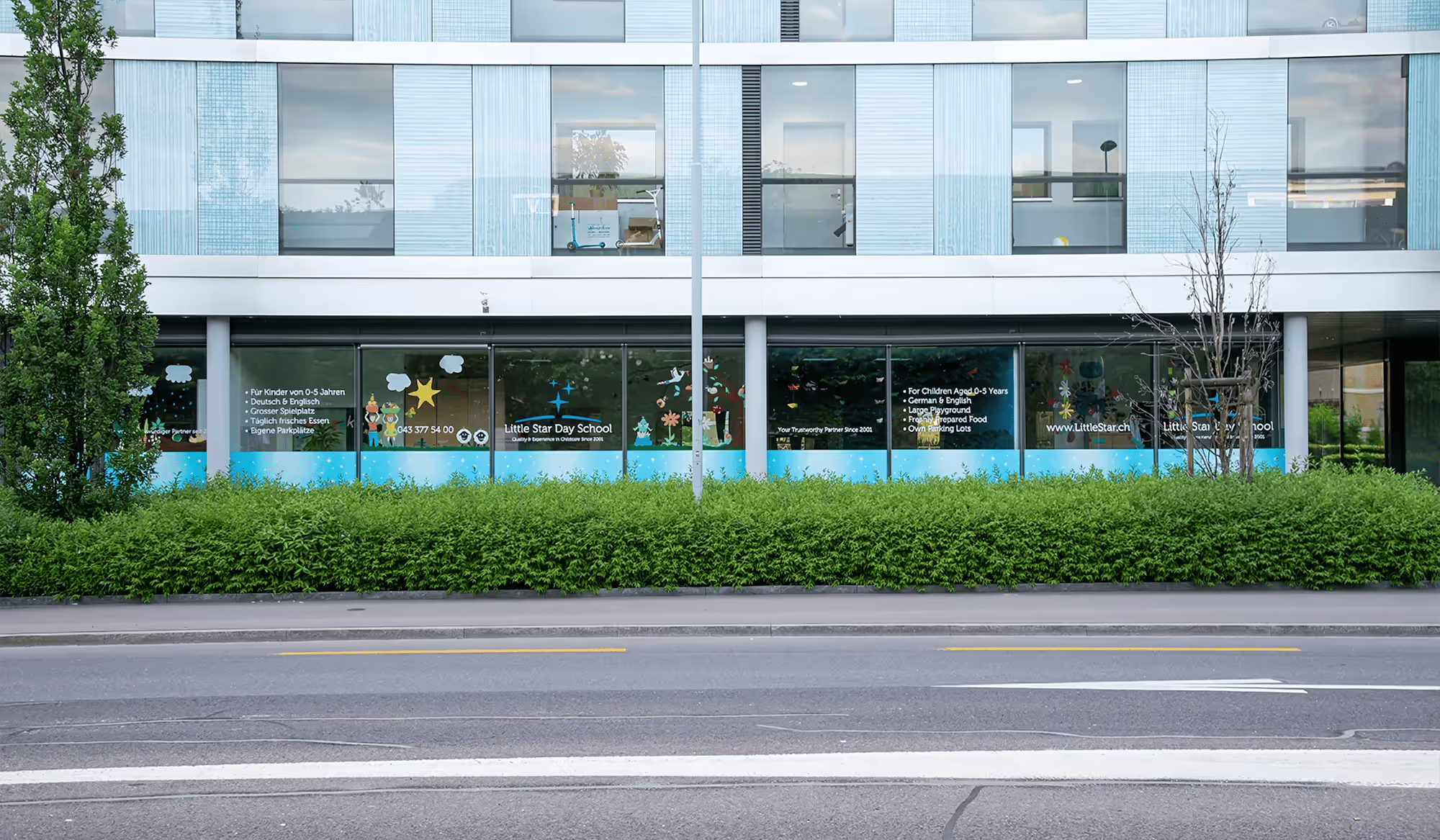
Our nursery is located in the modern Zuger Stadttor development on the boundary with Baar – directly opposite V-ZUG, a stone's throw from the Metalli shopping arcade and with direct access to a sheltered playground. This setting links the city centre with the quieter residential neighbourhoods of Baar and makes the nursery easy to reach from across the catchment area.
Just a few minutes away – from the centre of Zug, from Baar or via motorway exit 3 towards Baar. Plenty of parking is available for our parents right on site.
By bus: route 3 to Kistenfabrik, then about a 4-minute walk.
By train: the S1 or S2 to Baar Lindenpark – from there it is only about a 3-minute walk.
In this section you will find answers to frequently asked questions. Do you have further questions, or would you like a personal consultation? Then get in touch with us – we look forward to hearing from you!
The City of Zug states that, from August 2026, families with a relevant income below CHF 40,000 will pay from just CHF 10 per day of childcare. Families who are not entitled to the city voucher still benefit from the income-independent cantonal flat rate.
The cantonal flat rate is a new financial contribution from the canton of Zug towards the cost of childcare in nurseries and with childminders. It amounts to 33% of the average childcare fees in the canton of Zug and is paid regardless of income or assets, provided the conditions are met. It comes into force on 1 August 2026.
Eligibility applies to legal guardians whose child lives in the canton of Zug, is older than three months and not yet in compulsory kindergarten, and is cared for in a licensed nursery or registered childminding family. In addition, all legal guardians must be in employment or in state-regulated education. There is no prescribed number of working hours – part-time counts too.
The amount depends on your relevant family income and the level of childcare. According to the City of Zug's announcement of 7 May 2026, families with an income of up to CHF 40,000 will pay from just CHF 10 per day from August 2026. Above an income of around CHF 160,000, there is no longer any entitlement to city vouchers; the cantonal flat rate, however, is unaffected.
Yes. The two contributions are expressly designed to be combined. According to the City of Zug, the canton's new co-funding means families pay up to 71% less than before. Important: the canton's and city's contributions combined may not exceed the actual cost of childcare.
No later than the month before childcare begins. Entitlement starts from the month after you submit your complete application. Backdating is not possible – if you want to start from August 2026, you should see to it in good time.

.svg)

.png)
.png)
Designed with 🩵 by EINSHOCH