



.svg)
.svg)


Timing: 6:00am-2:00pm
Educational Games for Children Aged 2 and Up: Which games truly make a difference? 🧩 Fine motor skills ✓ Language development ✓ Social behaviour ✓
Entdecken Sie Little Star Day School

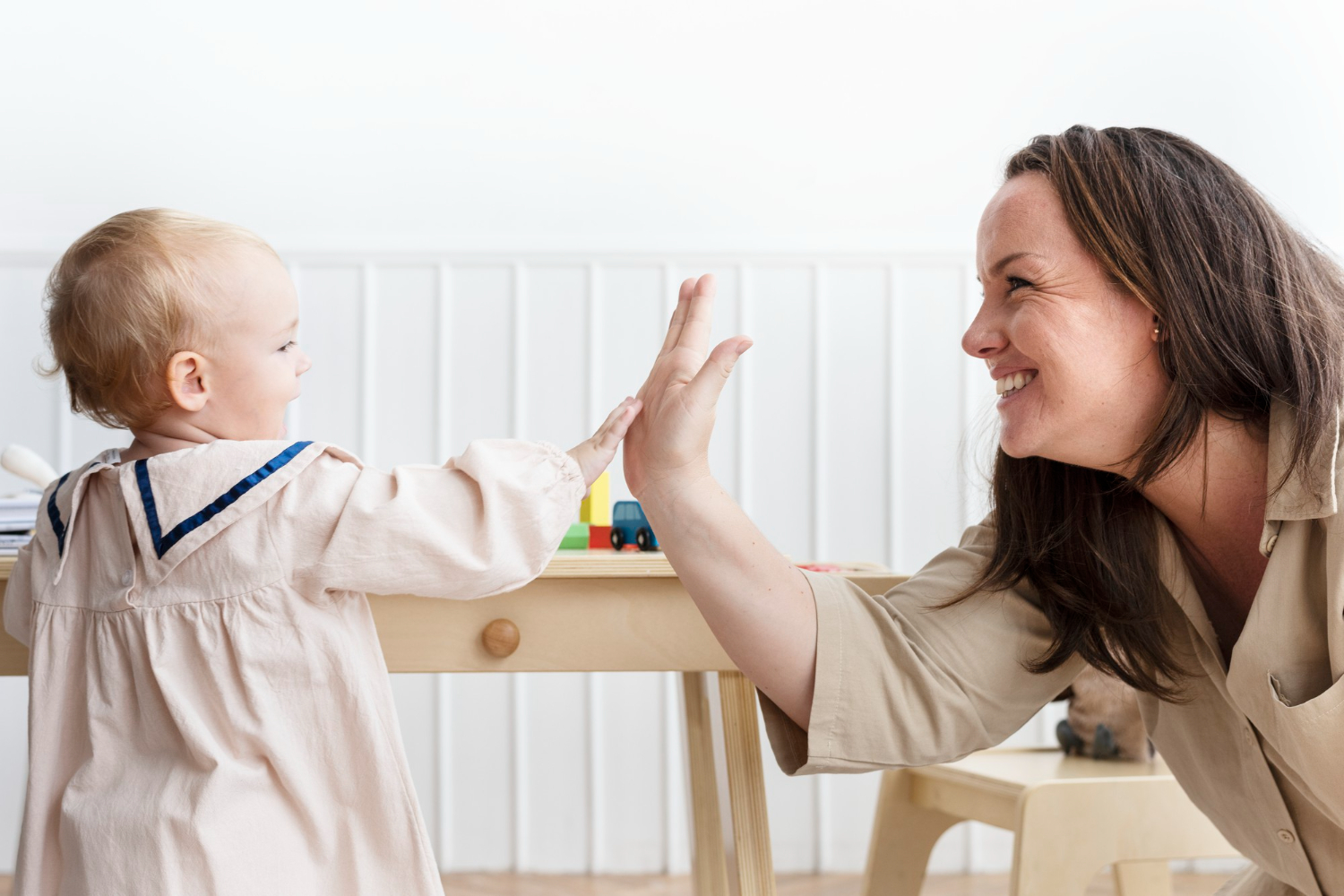
Do you remember the moment your child first shouted "By myself!"? Perhaps while putting on shoes, holding a spoon, or pressing a door handle. This little exclamation marks one of the most exciting transformations of early childhood: the baby who once observed the world becomes a two-year-old who wants to conquer it.
At the age of two, something remarkable is happening inside your child's head. They begin to understand that a building block isn't just something to throw – it can also be a telephone, a piece of cake for teddy, or a car zooming across the carpet. This ability to give meaning to objects is the starting signal for everything that follows: language, imagination, logical thinking.
At the same time, you as parents face new questions: How do I keep my child meaningfully occupied? Which educational games for children aged 2 and up actually make a difference – and what's just colourful plastic with batteries? How much should I join in, how much should I step back?
This guide gives you answers. Not with a wagging finger, but with concrete games you can try tomorrow morning. You'll discover why threading pasta is better for learning to write than any pencil – and why your child turns their back on the other child in the sandpit (spoiler: that's completely normal).
Before we get to the specific game ideas, it's worth taking a quick look behind the scenes. Because once you understand what's going on inside your child, many behaviours suddenly make sense – and you'll automatically choose the right games.
Does this sound familiar? Your child holds a building block to their ear and says "Hello Grandma!" Or they feed teddy with an empty spoon, making "Mmmmh, yummy!" sounds.
What's happening here is a small miracle: your child has learnt that things can mean something. The block is no longer just a block – it can be anything their imagination makes of it. Developmental psychologists call this "symbolic thinking", but really it's the beginning of everything: language, creativity, even mathematics later on (because numbers are just symbols too).
At around 18 months, a child still examines an object primarily physically: What does it taste like? What happens if I throw it? From their second birthday, the question becomes: What could this be? What can I play with it?
What this means for choosing toys: Toys no longer need to simply "work" (press button = noise). They can be open-ended, transformable, imagination-sparking. A cardboard box is often more exciting than the toy that came inside it.
"But I want to do it alone!" – accompanied by tears when you try to help. The so-called defiant phase often wears parents down. But here's the good news: this behaviour isn't a problem. It's a sign of healthy development.
Your child is discovering that they are an independent person. They have a will. They can make things happen. When they finally slot the right shape into the sorting box after ten attempts, something important happens in their brain: it releases feel-good hormones. The child learns: "I did it. I can do this."
This feeling – experts call it self-efficacy – is the engine for all future learning. Children who experience it often will later have more confidence to try new things.
What this means for choosing toys: The best games are those that challenge your child without overwhelming them. If something is too easy, it becomes boring. If it's too hard, it frustrates. The sweet spot lies in between: "This is tricky, but I can do it – perhaps with a little hint."
Your role in this? Don't jump in straight away. Don't show the solution. Instead, wait, encourage, and at the right moment offer a hint: "Hmm, the tower's wobbly at the bottom. What could we do differently there?" That way, the success stays with your child.
"We've just bought this expensive puzzle and after three minutes she wants something else!" Does that sound familiar? Then here's some reassurance: it's not the toy. And it's not your child. It's the brain.
The attention span of toddlers is simply limited – not from lack of interest, but for neurological reasons. Here's an overview:
What does this mean in practice? If your child loses interest after five minutes, that's not failure – it's age-appropriate. A good play rhythm alternates between calm phases (puzzles, threading, drawing) and active phases (running, climbing, dancing). This way, your child stays in the flow without becoming overwhelmed.
By the way: if your child concentrates for longer than these guidelines because they're completely absorbed – then you've hit the jackpot. Don't interrupt them. This deep immersion is pure gold for development.
When your child tries to pick a raisin crumb off the table – with thumb and forefinger, highly concentrated, tongue poking out with effort – they're training something important: their fine motor skills.
These small finger movements are far more than just play. They lay the foundation for everything that will later happen with their hands: doing up buttons, pulling up zips, holding a pencil, tying shoelaces. The more skilful their fingers become now, the more independent your child will be – and the less you'll hear "Mummy, can you just...?"
The lovely thing is: the best exercises cost almost nothing and children find them tremendous fun.
Threading games are so popular because they train exactly what two-year-olds are currently learning: coordinating both hands at the same time (one holds, one threads) and gripping small things precisely.
What you need:
Preparation (already fun): Put pasta with some colouring and a splash of vinegar into a freezer bag. Your child can shake vigorously – that's motor skills training before the actual game even begins. Then leave to dry on baking paper.
How to play: Tie a piece of pasta to the end of the string so the necklace doesn't come undone again. Show your child slowly and without too many words how the string goes through the hole. Then hand it over.
If it's too difficult: Start with pipe cleaners instead of string. They're stiff and don't bend away – much easier for beginners.
If it becomes too easy: Let your child thread colour patterns: red-yellow-red-yellow. This also trains pattern recognition – an important early maths skill.
Have you ever noticed how fascinated children are when they're allowed to pour something from one container into another? These "exercises of daily living" – as Maria Montessori called them – are simpler than any toy and more effective than most.
What you need:
Here's how: The child pours the contents from one container into the other. Back and forth. Again and again. What looks boring to adults is utterly fascinating for two-year-olds.
What's happening:
Tip: Place a tea towel under the tray. Then at the end you can roll everything up and pour it back – no hoover required.
The world is often overwhelming for two-year-olds. So many impressions, so many things! When children sort – by colour, shape or size – they create order in the chaos. This gives them security. And as a bonus, sorting is a mathematical warm-up exercise.
Set up three containers (bowls, cups or boxes with coloured paper stuck on) – one red, one blue, one yellow. Next to them, a pile of colourful objects: building blocks, buttons, pompoms, toy cars.
Now explain: "The red monster is hungry! It only eats red things. Can you feed it?"
What's happening: Your child has to look carefully (What colour is this?), select (Red, not blue!) and ignore other options. That sounds simple, but it's real mental work.
Making it harder:
Two-year-olds are not creatures who like to sit still. They want to run, climb, jump, roll, balance – preferably all at the same time. And that's a good thing.
Because movement isn't just burning off energy (although that helps too). Movement is learning. When your child climbs over cushions, they learn to judge their body in space. When they throw a ball, they practise controlling force. When they stand on one leg, they train balance and concentration.
In short: a child who moves a lot learns better – including things that seemingly have nothing to do with movement.
It's pouring outside, your child is getting wound up, and you're wondering how you'll survive the next two hours? Time for an obstacle course.
The principle is simple: you build a small circuit through the room using whatever's to hand. Your child has to crawl, climb, balance and throw – burning energy while getting to know their body along the way.
The Tunnel: Two chairs one behind the other, a blanket over the top. Your child crawls through. It sounds trivial, but it trains spatial awareness: How big am I? Will I fit through there?
The River: A blue towel or masking tape on the floor – that's water, you mustn't fall in! Your child has to balance or jump over it. Variation: walk sideways along the edge like on a narrow jetty.
The Mountain: A stack of firm sofa cushions or an upturned mattress. Climb up, stand at the top, jump down. Children love height – and learn to control their bodies in the process.
Target Throwing: A laundry basket and rolled-up socks. Who can score? This trains hand-eye coordination and the ability to judge distances.
A Little Tip in Passing: Watch your child at the individual stations. Do they hesitate before the tunnel? Are they reluctant to climb the cushion mountain? That's not a problem – it simply shows you where your child still feels unsure. Encourage gently, but don't push. Next week, the world will look quite different.
Many people know this game from nursery – but it works at home too, even with just two of you.
What you need:
Here's how: Everyone holds the sheet at the edge. The balls go in the middle. Now shake – and the balls bounce like popcorn in a pan. The aim: shake as wildly as possible without the balls flying out.
Why children love it: It's loud, it's wild, and it only works when everyone joins in. Your child learns, without even realising, to synchronise with others – you have to lift up together, lower down together. That's teamwork at toddler level.
Variation for wild days: "Who can shake all the balls out?" – then things can really get going.
Variation for winding down: "Can we wobble so gently that not a single ball falls out?" – suddenly, boisterous play becomes concentration.
Many two-year-olds are already riding balance bikes or zooming around on ride-on toys. If you have a long hallway or a driveway: make use of it.
Set up a few obstacles – plastic cups, upturned buckets, cushions. Your child has to drive around them without knocking anything over.
What's happening: Your child has to look ahead (Where's the next obstacle coming?), steer and brake – all at the same time. That's more demanding than it looks, and trains exactly the kind of planning that's also important for thinking.
Making it harder:
At some point it happens: your child sits in front of a problem – and instead of simply bashing away, they pause. They look. They think. They try something. It doesn't work. They try something else.
Welcome to the world of logical thinking.
At the age of two, children begin to understand that things belong together, that there's cause and effect, that a big whole is made up of small parts. That sounds abstract, but it shows itself quite concretely: when doing puzzles, when searching, when remembering.
The following games aren't "brain training exercises" – they're what children want to do anyway. We just need to provide the right materials.
Puzzles are the classic among thinking games – and for good reason. A child doing a puzzle learns: this big picture is made up of individual pieces. And I can put it together.
But take note: not all puzzles are the same. What's perfect for a three-year-old frustrates a two-year-old – and conversely, an older child gets bored with a baby puzzle. Here's some guidance:
Stage 1 – With Knobs (approx. 18–24 months): These puzzles have few pieces with small knobs for gripping. Each piece has its own recess – the child only needs to find the right shape. It's not about the picture yet, but about fitting in.
Stage 2 – Without Knobs, Few Pieces (approx. 24–30 months): Now it gets more interesting. 4 to 9 pieces, no more knobs, and suddenly the child has to pay attention to the image: Where's the dog's head? Where does the sky go?
Stage 3 – Floor Puzzles (from approx. 30 months): Large pieces that are spread out on the floor. The child has to move around to fetch and place pieces. Puzzling becomes a whole-body activity.
The Trick We Must Tell You About:
Is your child despairing over the puzzle? All the pieces flying across the room? Try this: secretly build the puzzle almost to completion – and leave only the last two or three pieces.
Your child puts these in and experiences: "I did it!" This success motivates them to try with more pieces next time. Much better than twenty minutes of frustration.
The classic memory game with face-down cards is still too difficult for two-year-olds. Remembering where each card is when you can no longer see them? That overwhelms the memory at this age.
But there are variations that work:
Lay 6 cards face up on the table – three pairs. Point to one card: "Look, a dog! Where's another dog?"
Your child searches for the matching picture. This trains careful looking: The dog here is brown and sitting, the one over there is also brown and sitting – they belong together!
Making it harder: Add more pairs. Or use cards that look similar (two different dogs), so your child has to distinguish more precisely.
This game is a hit – and you don't need cards, just three objects.
Here's how: Place three things on the table that your child knows: a car, an apple, a spoon. Name them together. Then say: "Close your eyes!" (Or hold a cloth over them.)
You take one object away and hide it behind your back. "Open your eyes! What's missing?"
Your child has to remember what was there – and notice what's no longer there. This trains exactly the kind of memory that becomes important for learning later on.
Making it harder:
Sounds simple, but it's a real thinking game: you hide something, your child searches.
At around two years old, children understand that things continue to exist even when they can't see them. (Before that – believe it or not – this wasn't a given.) Now they can remember: the ball disappeared under the cushion. So it must still be there.
For beginners: Hide an object under one of two cloths – right before your child's eyes. "Where's the bear?" Even if it looks easy: your child is practising remembering and acting on it.
A bit harder: Hide the object while your child isn't looking. Now they really have to search – and go about it systematically.
For little experts: Hide three objects in different places around the room. "Can you find all three?" This requires planning: Where have I already looked? Where haven't I?
"What's that? And that? And that over there?" – When your child enters this phase, you know: language is exploding right now.
At around 18 months, most children speak about 50 words. Sounds like a lot? Just wait. At two, it's suddenly 200 to 300. At two and a half, already 500. And at three? Approximately 1,000 words – plus whole sentences.
This window is wide open. Your child is soaking up language like a sponge. Everything you offer now in terms of words, songs and stories falls on fertile ground.
The best part: language development doesn't need expensive materials. It mainly needs one thing – you. Your voice, your attention, your joy in storytelling.
Busy books are brilliant because they have no text. No story you have to read "correctly". Instead: complex scenes full of details waiting to be discovered.
The Searching Game: "I can see something red that you can eat. Can you see it too?" Child: "Apple!" You: "Yes! A big, red apple. It looks juicy, doesn't it?"
The Storytelling Game: Point to a character: "Look at that man there. What do you think he's doing? Where's he going?" There's no right answer – your child can let their imagination run wild, and you join in.
The Sound Game: "That dog there – what noise does it make?" (Woof woof!) "And the car?" (Brum brum!) Sounds silly, but it trains sound formation and children find it tremendous fun.
Why this works so well: With classic reading aloud, children listen. With busy book conversations, they speak themselves. They search for words, form sentences, invent stories. That's more active – and sticks better.
Nursery rhymes and songs work like language lessons that don't feel like lessons.
When your child sings "Pat-a-Cake", quite a lot is happening in their head:
Experts call all this "phonological awareness" – but you can simply call it this: your child is getting a feel for how language sounds and is constructed. That's exactly what they'll need later for reading and writing.
"Horsey Horsey": Movement + language + building suspense ("If he falls down...") – children love the repetition and the predictable ending.
"Five Little Ducks": Simple melody, clear words, animals to imitate. Perfect for beginners.
"Incy Wincy Spider": There's a little drama in this one: the spider climbs up, gets washed down by the rain – everyone feels sorry for it – and in the end it climbs up again. Children learn to connect emotions with words.
Tip: Sing even when you think you "can't". Your voice is more familiar and more beloved to your child than any Spotify playlist.
The simplest language development costs nothing and happens along the way: narrate what you're doing.
"Right, now we're opening the dishwasher. Look – there's still water in there! The water's draining away now. Glug, glug, glug. Now we're taking the plate out. It's still warm!"
Sounds strange? But it's worth its weight in gold. Your child hears new words (dishwasher, drain, warm), learns connections (first open, then take out) and links language with real actions.
What matters here:
A scene many parents know: you go to the playground with your two-year-old, full of hope for nice playmates. And what happens? Your child sits down in the sand, builds away – and completely ignores all the other children. Or worse: they grab another child's toy and shout "Mine!"
Before you wonder whether you're doing something wrong: this is normal. Completely normal.
At two years old, children do discover that other children exist and are interesting. But actually playing together? That comes later. What we're seeing now is the beginning of a development – not the finished product.
Children learn social play in stages. This isn't theory from a textbook, but something you can observe at any playground:
What Does This Mean for You?
If your two-year-old sits in the sandpit next to another child and both dig away in silence – congratulations. That's exactly what this age is capable of. Don't force togetherness. Enable encounters, but don't expect teamwork yet.
Practical tip: When meeting up with other parents, bring two of popular toys (two spades, two cars). This dramatically reduces conflicts – and removes the pressure of "having to share".
"Now it's the other person's turn!" – this sentence rarely sparks enthusiasm in two-year-olds. And there's a reason for that: taking turns is genuinely hard work for a child's brain.
Your child has to suppress the impulse to have the toy RIGHT NOW. They have to be able to wait. They have to understand that they'll get the thing back. These are skills that only mature slowly.
Sit opposite your child, legs apart. Roll a ball back and forth. Sounds boring? It isn't.
The trick: commentate on possession.
What's happening: Your child experiences physically that giving something up doesn't mean losing it. The ball does come back. Again and again. This experience builds trust – and makes sharing easier later on.
Making it harder: Build in small pauses. "I'm keeping the ball a moment longer... and... now!" This gradually stretches the waiting time.
Two-year-olds have all the feelings that adults have – joy, anger, fear, sadness, jealousy. There's just one thing they don't have yet: the ability to regulate these feelings.
Hence the tantrums in the supermarket. Hence the hysterical crying because the biscuit broke. The feeling is real and overwhelming – even if the cause seems small to us.
Games can help children get to know and name their feelings. Because those who can name their feelings can handle them better.
What you need: A large dice (made from cardboard or a foam cube), with faces stuck or drawn on each side: laughing, crying, angry, scared, surprised, tired.
How to play: Your child rolls the dice. Then you look together: "Oh, a sad face! Can you pull that face too?" (Child copies the sad face.) "When do you look that sad?" – "When my tower falls down."
Why this helps: Your child learns: there's a word for this funny feeling in my tummy. And everyone knows this feeling – even Mummy and Daddy. That alone is comforting.
Another Tip for Everyday Life:
Name feelings when you see them – in your child and in yourself:
You don't have to make the feelings "go away". Simply naming them helps.
Two-year-olds don't learn through explanations. They don't learn through watching. They learn by touching things, reaching in, bashing, smelling, putting things in their mouths.
This isn't a deficit, it's their programming. Their brain is designed to understand the world through the body. Water is wet – but the word "wet" means nothing before you've felt water. Sand trickles – but only when it runs through their own fingers does a child understand what that means.
That's why children at this age love everything they can touch, pour, squelch and explore. And that's why they love helping with real tasks – not because they're being good, but because real activities are more exciting than any toy.
Imagine packing a small universe into a shallow plastic tub. Water, sand, rice, beans – plus a few spoons, cups, sieves. And there you have a playground that can captivate your child for twenty minutes or longer.
What you need:
Here's how: Set everything up – and then step back. Your child will start scooping, pouring, sinking the stones and fishing them out again all by themselves.
What's happening (without you having to explain anything):
Variations for other days:
The Building Site Tub: Dry rice or lentils, small diggers, dump trucks, plastic cups as silos. Plus a few stones as cargo.
The Kitchen Tub: Uncooked pasta, wooden spoons, small pots. Your child "cooks" for their cuddly toys.
The Treasure Tub: Sand or semolina, hidden inside: coins, colourful stones, small figures. Your child digs for treasure.
A Note for Children Who Still Put Everything in Their Mouths: Use edible fillings: crumbled biscuits ("sand"), cooked pasta, jelly, whipped cream. Then it doesn't matter if something ends up in their mouth.
No toy in the world is as complex as a patch of woodland, a meadow or a stream bank. Nature offers everything little explorers need: endless textures, sounds, smells, things to collect.
The Collecting Walk: Give your child a small bucket or bag. The mission: "Today we're collecting everything that's on the ground." Leaves, sticks, stones, conkers, feathers – everything can go in. At home, the treasure is examined, sorted, perhaps stuck into a picture.
The Sound Hunt: Stop, go "Shhhh!" and whisper: "Who can hear a bird?" Then listen together. "Who can hear a car? Who can hear the wind?" This sharpens hearing – and children love the whispering and listening.
The Barefoot Path: If you have a garden: lay out different materials in a row – grass, sand, bark mulch, pebbles, a wet towel. Your child walks barefoot over them. Each surface feels different. "What's that like? Prickly? Soft? Cold?"
"I want to do it too!" – Your two-year-old wants to wipe the table, water the flowers, stuff the washing into the machine. This is no coincidence. Children at this age don't want to play at doing something real – they want to do something real.
Maria Montessori recognised this over a hundred years ago: children learn most when they're allowed to participate in real activities. Not in child-friendly plastic versions of them, but in the real thing.
Five Household Tasks That Two-Year-Olds Can Manage:
The most important point here: it takes three times as long as doing it yourself. The socks aren't properly paired afterwards. The table is even more smeared than before. That doesn't matter.
It's not about the result. It's about your child experiencing: I can contribute. I'm important. I can do this. This feeling is worth more than a perfectly wiped table.
One final thought that brings everything together: children don't need mountains of toys. They need opportunities to do.
A room full of plastic clutter overwhelms and paralyses. A tidy space with few, well-chosen things invites play.
What helps:
The principle behind it: the less choice, the deeper the play. A child with three cars builds a garage, a petrol station, a race track. A child with thirty cars just rummages in the pile.
If you've read this guide all the way through, you now know a great deal about threading games and messy tubs, about busy books and living room obstacle courses. But the most important thing you've probably sensed already: it's not about the perfect toy. It's not about elaborate development programmes. It's about time. Your time.
A child who threads pasta together with you learns more than a child sitting alone in front of the most expensive educational toy. A child who sings with you – even if you hit every note wrong – develops more feel for language than in front of any app. A child who's allowed to sort socks beside you grows more from this "boring" task than from an hour of early learning classes.
What Two-Year-Olds Really Need:
That's you. Not perfect, not always patient, sometimes frustrated – but there. That's enough. That's even more than enough.
Andere Blog-Artikel

.svg)

.png)
.png)
Designed with 🩵 by EINSHOCH





.svg)